


For Hospitalists from the Palliative Care Team
Bottom line: Does your patient have difficult to control symptoms or other complex needs getting in the way of receiving good palliative or end-of-life care? Don’t hesitate to contact us at Palliative Services through switchboard for help!
Why are we reaching out to you? We are hearing from many providers that there is a lack of awareness about palliative care services in hospital and community, what’s available and how to access them. Our interdisciplinary service has grown significantly in the past decade, and patient needs are becoming more complex. Given that the Hospitalist service does the majority of the inpatient palliative care for patients in the South Island, we wanted to make sure you have the most up-to-date information, and are “in the know” about how to access specialty palliative care.
Please note palliative care gets involved with patients facing life-limiting illness. If your patient has complex chronic pain or debilitating symptoms in the absence of a life-threatening diagnosis, we will NOT see them.
Here’s how we think of our work below. We step in in the coloured section (not the gray).
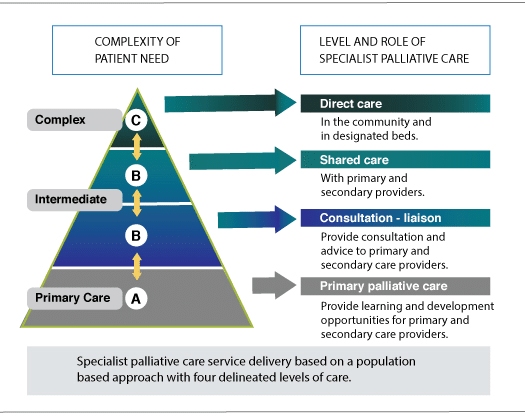
- Primary Palliative Care – this is often you while the patient is admitted, and the patient’s family physician/NP or other specialist (e.g. oncologist) once discharged back to the community. Feel free to reach out to us at any time if we can help support or advise on symptom management issues, or for any system navigation questions.
-
- Prognosis 6-12 months or less, nearing discharge:
-
-
- Don’t forget about registering the patient with Pharmacare’s Palliative Benefits Plan (aka Plan P) if you think they qualify to unlock significant financial benefits for them! If you include the FAX NUMBER for the unit you send the form in from in your contact info, they will fax you back approval/refusal. Expect reply within 24 hrs on business days.
- At this stage of illness, this is also good time to also refer to home care nursing (write order for hospital nurse to refer to CHS for nursing support on discharge, include diagnosis and rough time frame for follow-up e.g. “pls refer to CHS nursing f/u re Renal cancer by mid-next week”) and update their MOST.
-
-
- My patient has stabilized medically, but can’t return home again:
-
-
- Explore if appropriate for transfer to a Hospice bed (prognosis 3 months or less with MOST M2 or M1). Here’s the Hospice Bed Request package – MRP to complete Referral form only, CNL to complete the rest with patient/family.
- Please note there are hospice beds available at Victoria Hospice at RJH (18 beds; complete discharge summary and transfer med rec; no MD-to-MD handover required) and Ayre Manor in Sooke (2 beds); patients from the peninsula may palliate at the SPH Palliative Care Unit.
- Many palliative patients with a longer (>3 month) prognosis who can’t be supported at home will need transfer to LTC – involve your liaison early!
-
-
- Checklist for patients being discharged home for end-of-life care (final hours to short weeks):
-
-
- Community EOL Order Set includes most of what your patient may need (ask unit clerk to fax a copy to the home care nurse and to the patient’s community pharmacy).
- Still need to send the duplicate Rx to the pharmacy, even with this order set
- Send Plan P and Rx for injectable meds at least 24 hours prior to discharge – injectable meds often have a delay of 1 business day to arrive
- Contingency planning if urgent discharge: can hospital pharmacy provide “pass” doses of essential medications in drawn up syringes to bridge community supply? Can inpatient nurse start subcut lines even if not yet needed?
- Community EOL Order Set includes most of what your patient may need (ask unit clerk to fax a copy to the home care nurse and to the patient’s community pharmacy).
-
-
-
- Expected Death in the Home form. You can indicate that patient’s primary care physician can complete the death certificate; however if PCP has not been recently involved it still may come back to you.
-
-
-
- Patient copy of MOST (can print from Powerchart); serves as community DNAR
-
- Refer/update to CHS nurse and FP/NP to receive the patient in community:
- In Greater Victoria (including Peninsula; excluding Sooke):
- Write order for nursing to ask CHS nurse to refer to Victoria Hospice upon discharge (current: registration with Victoria Hospice; changing to Consent to Contact Form in late 2026) and request CHS nurse in-home visit within 24 h of discharge
- Feel free to give patients the direct Victoria Hospice telephone number 250-370-8715 to ensure no gaps in care.
- In Sooke:
- Write order for nursing to request CHS nurse conduct in-home visit within 24 h of discharge
- For patients who reside in Sooke catchment and require physician support for their end-of-life care (community or Ayre Manor Hospice bed admission), a direct physician to physician referral to the Sooke Family Physician Group via Dr Tracy Forsberg to assume MRP. Dr. Tracy Forsberg @ West Coast Family Medical Clinic Doctor’s Line: 250-642-6761
- Remainder of the island:
- Contact Palliative Care Physician on call for consult to facilitate discharge.
- In Greater Victoria (including Peninsula; excluding Sooke):
Rapid fire community palliative care Q & A
How often does a home care nurse see patients?
- When stable –phone check in’s q.2-4. weeks, more often p.r.n.
- When unstable or final days – daily home visits (this is the maximum)
How much support is provided to patients in community?
- Up to 4 hours per day of publicly funded home supports (personal support worker) when on Plan P – NB: cannot give injectable or p.r.n. meds
- Equipment rental including hospital bed, walkers, etc.
- Private agencies can offer more but financially prohibitive for most
What does registration with Victoria Hospice do?
- The patient and their family get a folder of information from their home care nurse including anticipatory guidance on common symptoms and practical information such as funeral planning resources.
- Patients do NOT need to be registered to access the Palliative Response Team if this service is required (see below for what PRT is).
- Process for supporting palliative community patients is changing in late 2026: patients will no longer be “registered” with Hospice but rather can be referred by a physician or self-refer for an intake call from Hospice and delivery of tailored resources such as child and youth counselling, volunteer, care navigator.
What is the Palliative Response Team (PRT)?
- A single back-up/urgent response team to support the home care nurse and family physician/NP for palliative patients experiencing a sudden or unexpected crisis; goal is symptom support and avoiding ER / hospital for palliative situations that could be managed at home. Most suitable when MOST is M3 or less and home care nursing already involved.
- Consists of a counsellor and nurse with a palliative drug kit, with access to the palliative care physician on-call for orders.
- Geographic boundary from Saanich Peninsula to the bottom of the Malahat to Westshore (excluding Sooke)
- Service is 24/7 (however is only one nurse for the greater Victoria area who triages based on need, so we usually frame it as telephone advice ALWAYS, and MAY involve the travel nurse attending the home). Like all of healthcare, sometimes short-staffed.
- PRT follows a patient for a short period of time only (approx. 3-5 days), until acute symptoms have settled, or they go to hospital/hospice, or they die at home.
- PRT is usually called in by a home care nurse, or if the patient/family calls Victoria Hospice directly and the Hospice nurse thinks the PRT is needed.
What can and can’t be done in community for palliative patients in the South Island?
- What is possible:
- Provide access to primary palliative care (FP/NP and home care nurse) and escalate to expert palliative care if needed (intensive home-based specialist palliative care support – physician, nurse consultant, psychosocial consultant and PRT)
- Run continuous subcut medication infusions to support complex home deaths, e.g. status epilepticus, refractory delirium
- Organize home oxygen (funded if hypoxic, otherwise private pay)
- Organize same day or next day investigations; organize outpatient paracentesis, thoracentesis, blood transfusions (NB: usual delay of a week)
- Organize direct admissions to Hospice and PCU for patients who meet criteria
- Support patients who have difficulty accessing palliative care services due to factors such as isolation, poverty, housing insecurity, substance use, mental health issues, etc. via Palliative Outreach Resource Team
- Provide consultative counseling and bereavement support for adults as well as children & youth
- What is NOT possible
- Give IV fluids/meds/blood or use central lines (NB: hospital at home is an exception as these are considered inpatients!)
- Safely manage medical acuity that requires urgent imaging, labs, monitoring, when a person is hopeful for life-extending interventions (e.g. a patient with a MOST C2 and a life-limiting diagnosis is better served in acute care/ER)
- Provide 24/7 in-home nursing care: we rely heavily on the patient’s own support people to provide the bulk of the personal care and subcutaneous medication administration (with home care nursing support and oversight)
- Intermediate Complexity Palliative Care: For a smaller number of patients, we are happy to provide some advice or see the patient in consultation +/- follow along to monitor their symptoms. For inpatients at SPH, call us through switchboard. We are a part-time consulting service but we have 24/7 on-call availability based out of RJH and want to support you with your urgent or complex cases.
- Reminder about our PORT (Palliative Outreach Resource Team) service available for phone advice for SPH based patients before discharge home/to shelter/other, for patients who may be facing systemic barriers to equitable access to palliative care services. For inpatients, call switchboard; for outpatients, referral form here.
- Complex Palliative Care: For the smallest number of the most complex patients, we may assume MRP by seeing in consultation and then coordinating care, often to our tertiary Palliative Care Unit at RJH (for medical>nursing complexity) or our Hospice beds (for nursing>medical complexity). Contact information as above, and a decision support tool if you’re uncertain. Again, if you feel like your patient needs help with symptoms or you just have questions, contact us through switchboard!
We are friendly. We are KEEN to be helpful to you, your patients and their (chosen) families to ensure they receive the support/care they need.